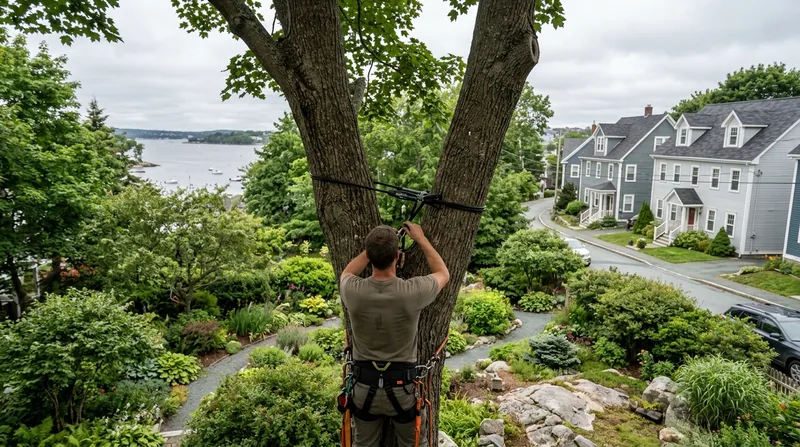




Tree cabling and bracing in Halifax protects mature trees with structural weakness from failure during ice storms, windstorms or heavy snow loads. In the Halifax area, where mature maples, oaks and spruces often occupy tight residential lots and ravine properties, dynamic cabling preserves valuable trees that might otherwise require removal. Our ISA Certified Arborists assess each tree's condition and install cables or braces only when retention is the safe and reasonable choice. This service has been part of our work since 2014, and it remains one of the most effective ways to extend the life of a tree that matters to your property. Learn how we diagnose tree health before recommending structural support.
Why structural support prevents costly removals
Mature trees in Halifax neighbourhoods often develop weak branch unions, included bark, or a lean that makes them vulnerable to splitting or uprooting. Ice storms and summer windstorms expose these flaws quickly. Rather than fell a healthy 40-year-old sugar maple or red oak, dynamic cabling stabilizes the weak points and allows the tree to remain standing. The system works by distributing load across multiple anchor points, reducing stress on the damaged union or stem. Installation takes a full day for most residential trees, and the cables remain in place for the life of the tree.
- Cables redirect lateral stress away from weak unions and splitting stems.
- Installation occurs after a full structural inspection and risk assessment.
- The system is invisible from ground level and does not harm the tree.
- Maintenance is minimal; we inspect cables annually during routine visits.
- Cost is typically 30 to 50 percent less than removal and stump grinding combined.
Once a cable is installed, the tree continues to grow and strengthen the surrounding wood, often healing the original weakness over time.
Local example: A 45-year-old silver maple in Halifax with a severe V-shaped union and a 60-degree lean costs $1,200 to $1,600 for cabling and bracing, compared to $2,200 to $3,200 for removal and stump grinding. The tree remains on your property and continues to provide shade and value.
How we inspect and install cables in the Halifax area
Assessment begins with a close visual inspection of the tree's crown, trunk and root collar. We look for included bark, bark-filled cracks, dead branches, lean, and signs of decay or disease. Our arborists then measure the distance between anchor points, determine the angle and tension needed, and select the appropriate cable diameter and hardware. Installation happens in one visit; we use certified climbing equipment and secure anchors to healthy wood at least 15 centimetres in diameter. The entire process is documented with photographs so you have a record of the work.
- We perform a full structural and health assessment before any installation.
- Cables are installed at the point of greatest stress, usually in the upper crown.
- Hardware is stainless steel and rated for the load and movement expected.
- We trim any dead wood and competing branches to reduce wind loading.
- Documentation and photographs are provided for your insurance file.
If the tree has multiple weak points or advanced decay, we may recommend removal instead. Honest assessment protects both you and the tree.
Typical timeline: Assessment and free estimate take 20 to 30 minutes. Installation for a single-cable system on a medium-sized tree (8 to 12 metres) takes 4 to 6 hours. Multi-cable systems on larger trees may require a second day. We schedule work in late fall through early spring when the tree is dormant and climbing conditions are safest.
Cable, brace and support systems we install
| System Type | Description | When We Use It |
|---|---|---|
| Dynamic cable | High-strength synthetic rope anchored at two or three points in the upper crown, allowing controlled movement during wind. | Weak branch unions, stem splits, moderate lean in healthy trees. |
| Rigid brace | Metal rod inserted through the stem to hold two halves of a splitting trunk in alignment. | Vertical or radial cracks in the main stem; trees with included bark and high failure risk. |
| Combination system | Cable and brace working together to stabilize multiple weak points on the same tree. | Large mature trees with both union weakness and stem splitting; high-value specimens. |
| Crown reduction | Selective pruning to reduce wind loading and stress on cables, often performed at the same time as installation. | Any tree receiving cables; reduces the load the system must carry and improves long-term stability. |
We choose the system based on the tree species, the location and severity of weakness, and your goals for the property. Structural pruning often accompanies cabling to remove competing branches and improve weight distribution.
Permits and safety considerations in Halifax
Tree cabling does not require a separate permit in Halifax for work on your own property, but the City of Halifax may require a permit if the tree is on a public right-of-way or if the work involves significant pruning. Our crews always maintain safe approach distances from private electrical service entrances (the wires running from the pole to your house). If a tree touches the public distribution lines operated by in Halifax and the surrounding area Power, we refer the situation to them and do not work on the tree until clearance is confirmed. Learn more about working safely near power lines.
We are fully insured and carry current certificates of liability coverage. Our arborists hold ISA certification and follow industry standards for cabling and bracing set out by the International Society of Arboriculture. Every job is documented with photographs and a written summary so you have proof of the work for your insurance file if needed.
When to schedule cabling and bracing work
Dormancy is the ideal season for structural pruning and cabling installation. Late fall through late winter (October through March) offers the safest climbing conditions and allows us to see the tree's full structure without foliage. Work performed during dormancy also minimizes stress on the tree and allows it to heal more effectively. If a tree shows signs of imminent failure (deep cracks, severe lean, or fresh storm damage), we respond urgently and can install temporary or permanent support year-round. Contact us immediately if a tree is leaning or cracked.
After installation, cables require inspection every 12 months to check for wear, corrosion or movement. We include one free inspection in the year following installation, and annual inspections thereafter cost $150 to $250 depending on tree size and access.
Getting a free estimate for your tree
Contact Citadel Tree Trimming at (902) 700-2952 or request a free estimate online. Describe the tree's location, size, and the problem you have noticed (lean, cracking, weak branch). Our arborist will visit your property, assess the tree in person, and provide a written quote for cabling, bracing, or any accompanying pruning. There is no obligation and no charge for the assessment. Most estimates are completed within 24 hours.
We serve Halifax and the surrounding municipalities including East Hants, West Hants and Chester. View our full service area.
Prices Tree Cabling & Bracing in Halifax — Indicative pricing
| Service | Price | Details |
|---|---|---|
| Single cable installation (8 to 12 metre tree) | From $1,200 | Includes assessment, cable hardware, installation and one year of annual inspections |
| Multi-cable system (large or complex tree) | From $1,800 | Two or more cables, rigid braces, or combination systems on mature specimens |
| Cable plus structural pruning | From $1,500 | Installation with crown reduction to reduce wind loading and improve long-term stability |
| Annual cable inspection | From $150 | Routine check for wear, corrosion, movement and tree health; first inspection included |
| Free estimate | Complimentary | Full structural assessment and written quote. Call (902) 700-2952 or submit online. |
Indicative prices; free, personalized estimate within 24h at (902) 700-2952.